The RESIL-Card tool

Empowering healthcare professionals to enhance the resilience of cardiovascular care

The RESIL-Card tool is a practical instrument designed to help European cardiovascular professionals strengthen the resilience of their care pathways.

It aims to contribute to ensuring the continuity of lifesaving care for patients with cardiovascular diseases during crises – such as pandemics, extreme climate events, geopolitical instability, cyber threats, among others.


What is resilience?

Resilience is the “… institutions’ and health actors’ capacities to prepare for, recover from and absorb shocks, while maintaining core functions and serving the ongoing and acute care needs of their communities.”
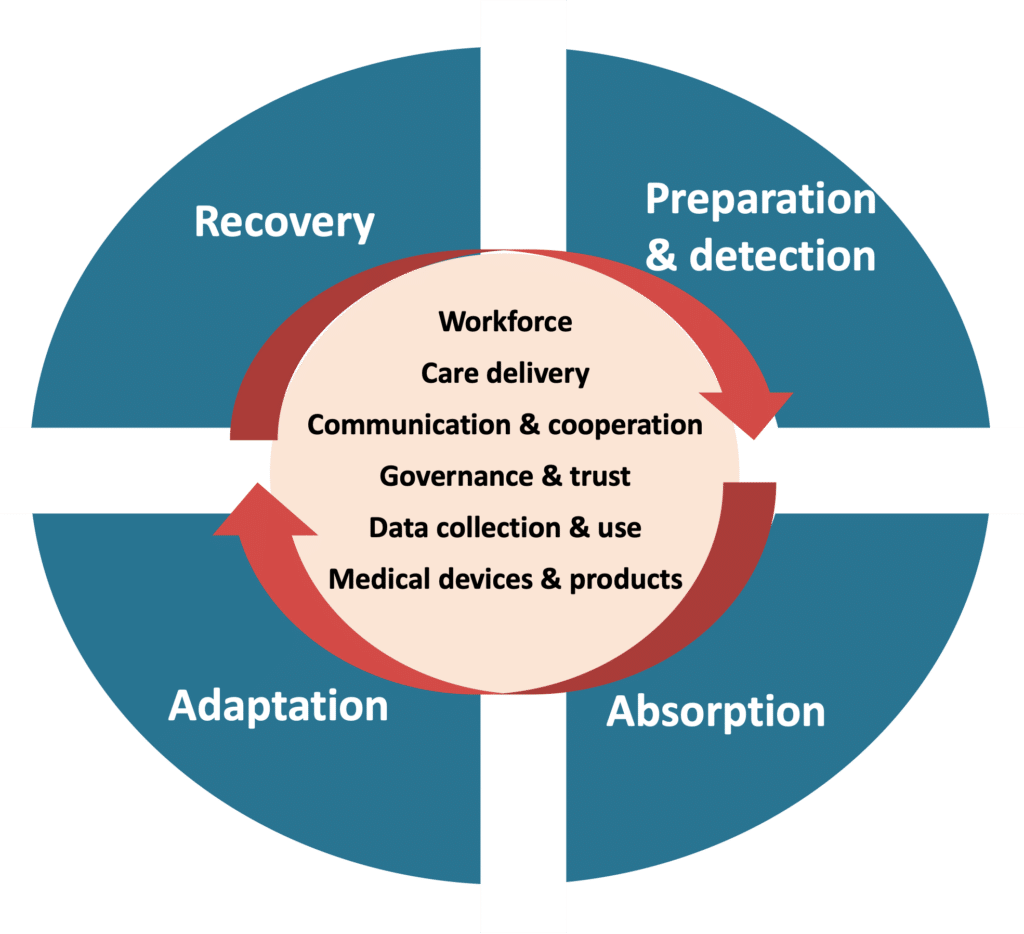
The four phases of the disruption cycle


A resilient health system has the ability of recovering and adapting from shocks that disrupt the entire health system.


Resilience dimensions

The development of the RESIL-Card tool involved the consideration of six resilience dimensions.
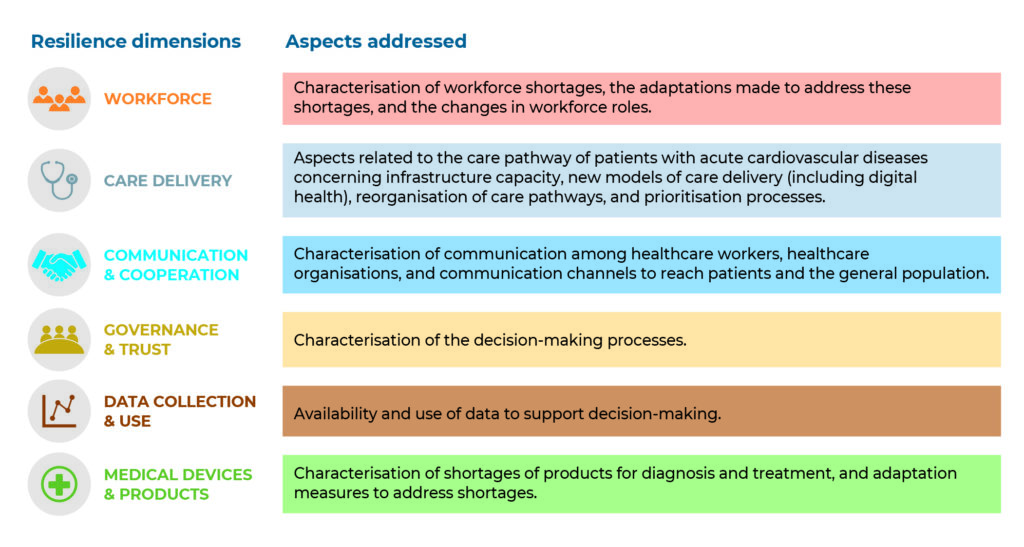


Enlarge image

Learnings from the COVID-19 crisis

During the COVID-19 pandemic, health professionals, cardiovascular patients and the general population suffered:

  • Reduced availability of healthcare services
  • Fewer patient presentations for both acute events and follow-up appointments
  • Diagnostic and treatment delays, with evidence of worsening outcomes
  • Unsafe working conditions, such as lack of personal protective equipment, extra working hours under high pressure


This situation resulted in:

  • Increased morbidity and societal costs
  • Increased mortality and morbidity amongst healthcare workers
  • Exhaustion from work routines
  • Professional career pivoting


The importance of strengthening health systems’ resilience

The impact of the COVID-19 pandemic underscores the importance of improving health systems’ resilience to ensure access and quality of care delivery during shocks.

It is crucial to establish robust methods to prioritise those who require urgent care, even during crises.

Stakeholders along the care pathway need tools to evaluate their preparedness and assess how they can enhance their resilience to ensure optimal care delivery when confronted with these threats.

The RESIL-Card project has developed this tool to help you assess the resilience of your centre’s cardiovascular care pathway by considering six key resilience dimensions.

According to Emami SG et al., A ‘crisis’ is defined as a period of heightened difficulty, danger, or uncertainty, often precipitated by unforeseen events that disrupt the standard operational frameworks within healthcare settings. ‘Shocks,’ on the other hand, are delineated as either acute or chronic based on their temporal characteristics.

Examples:

  • Interrupted accessibility
  • Supply shortage
  • Decline of trust
  • Compromised security
  • Communication blackout
  • Increase of demand
  • Workforce shortage


  • Haldane V et al. (2021). Health systems resilience in managing the COVID-19 pandemic: Lessons from 28 countries. Nature Medicine, 27(6), 964-980. https://doi.org/10.1038/s41591-021-01381-y
  • OECD (2023). Ready for the Next Crisis? Investing in Health System Resilience, OECD Health Policy Studies, Paris: OECD Publishing. https://doi.org/10.1787/1e53cf80-en
  • Rogers HL et al. Resilience testing of health systems: How can it be done? International Journal of Environmental Research and Public Health 18.9 (2021): 4742. https://www.mdpi.com/1660-4601/18/9/4742
  • Emami SG et al. (2024). Towards resilient healthcare systems: a framework for crisis management. International journal of environmental research and public health, 21(3), 286. https://www.mdpi.com/1660-4601/21/3/286
  • Carvalho ASV et al. Development of a resilience assessment tool for cardiac care pathways in Europe: a mixed-methods study. British Medical Journal. https://doi.org/10.136/bmjopen-2025-110266
  • Lunardi M et al. Predicted clinical and economic burden associated with reduction in access to acute coronary interventional care during the COVID-19 lockdown in two European countries. Eur Heart J Qual Care Clin Outcomes. 2024 Jan 12;10(1):25-35. https://doi.org/10.1093/ehjqcco/qcad025
  • Lunardi M et al. Impact of COVID-19 on STEMI outcomes in Sweden and France: an economic analysis. Under review

RESIL-Card is a resilience self-assessment tool developed by the RESIL-Card consortium within the framework of the RESIL-Card project funded by the European EU4Health program (#101129203). The tool was first made publicly available in March 2026.

Current version: v1.0.

DOI: XXXX (à mettre à jour après soumission dans Zenodo)

Initial public release: March 2026

Subsequent updates and revisions will be documented as part of the on-going development of the tool.

©2026 RESIL-Card consortium


This project has received funding from the European Union’s EU4Health work programme under grant agreement No. 101129203.

Views and opinions expressed are however those of the author(s) only and do not necessarily reflect those of the European Union or the European Health and Digital Executive Agency (HaDEA). Neither the European Union nor the grating authority can be held responsible for them.