As a partner of the RESIL-Card consortium, the international patient organisation Global Heart Hub has played a central role in shaping how cardiovascular services across Europe can better prepare for future crises and to ensure that resilience strategies genuinely reflect patient needs and real care experiences.
From the outset, patient representatives have been actively involved in developing the RESIL-Card tool. Their contributions have helped embed lived experience into the framework, ensuring that preparedness efforts address what matters most to people suffering from cardiovascular disease: continuity of care, safety, clear communication, and trust in healthcare systems.
When hospital resilience teams apply the RESIL-Card tool within their own institutions, they are encouraged to work with their existing patient organisation partner or to connect with their national Global Heart Hub representatives. Engaging patient organisations during the preparedness assessment process strengthens the quality of the evaluation and ensures that resilience planning remains responsive to patient realities.
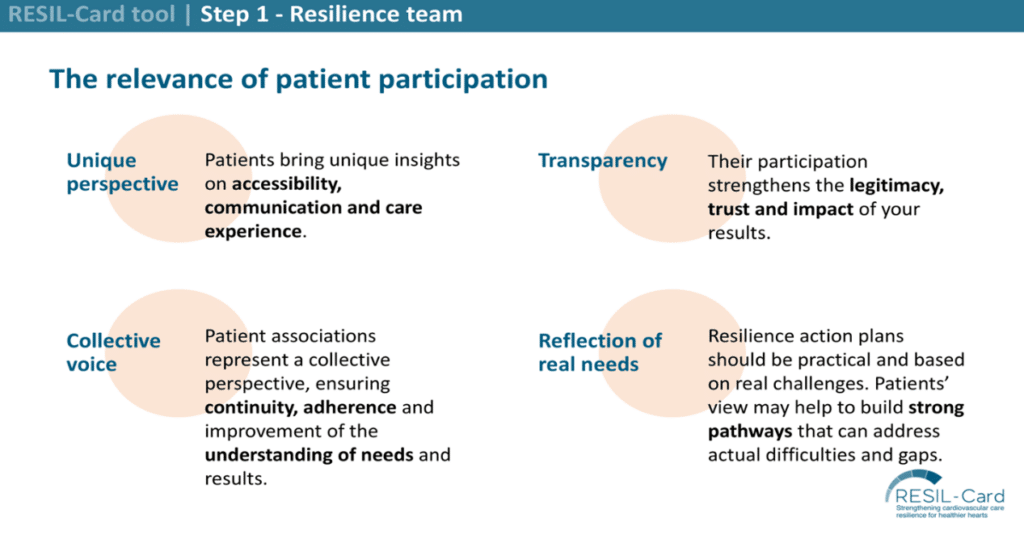
The importance of this collaboration was highlighted during a recent webinar (https://www.youtube.com/watch?v=1bxnN-N0Gpw), which explored how to safeguard continuity of lifesaving cardiovascular care during challenging times — whether pandemics, climate-related disruptions, or other systemic crises. The discussion reinforced why meaningful engagement with the patient community is essential to achieving sustainable preparedness.
During the webinar, Dr Juan Jose Rodriguez-Arias (Barcelona, Spain) shared his experience implementing the RESIL-Card tool during its pilot phase. The structured assessment enabled his team to identify key vulnerabilities and introduce practical improvements, particularly in patient communication and interdisciplinary collaboration. He emphasised that resilience planning must actively involve patients if services are to remain responsive and effective during periods of disruption.
Earlier in the session, Teresa Glynn of Global Heart Hub underlined the pivotal role patient organisations can play in strengthening resilience and achieving the best possible outcomes for patients. Her remarks reinforced the shared responsibility between clinicians and the patient community in building systems that are robust, adaptable, and centred on those they serve.
By strengthening the resilience of cardiovascular services, RESIL-Card ultimately supports:
- Greater reliability in care delivery
- Improved preparedness for future crises
- Enhanced patient safety
- Increased confidence in healthcare systems
The webinar reaffirmed a collective commitment among clinicians and patient organisations to work together in building more resilient cardiovascular care systems across Europe.
In a global health landscape increasingly shaped by uncertainty, proactive preparedness is no longer optional — it is essential.
As Global Heart Hub continues to mobilise its network of affiliated patient organisations to support dissemination of the RESIL-Card tool and amplify the patient voice in resilience efforts, cardiovascular professionals are equally encouraged to actively involve patient representatives in strengthening care pathway resilience. By working together, clinicians and patients can help ensure that cardiovascular care remains uninterrupted, equitable, and truly patient-centred — whatever challenges lie ahead.
